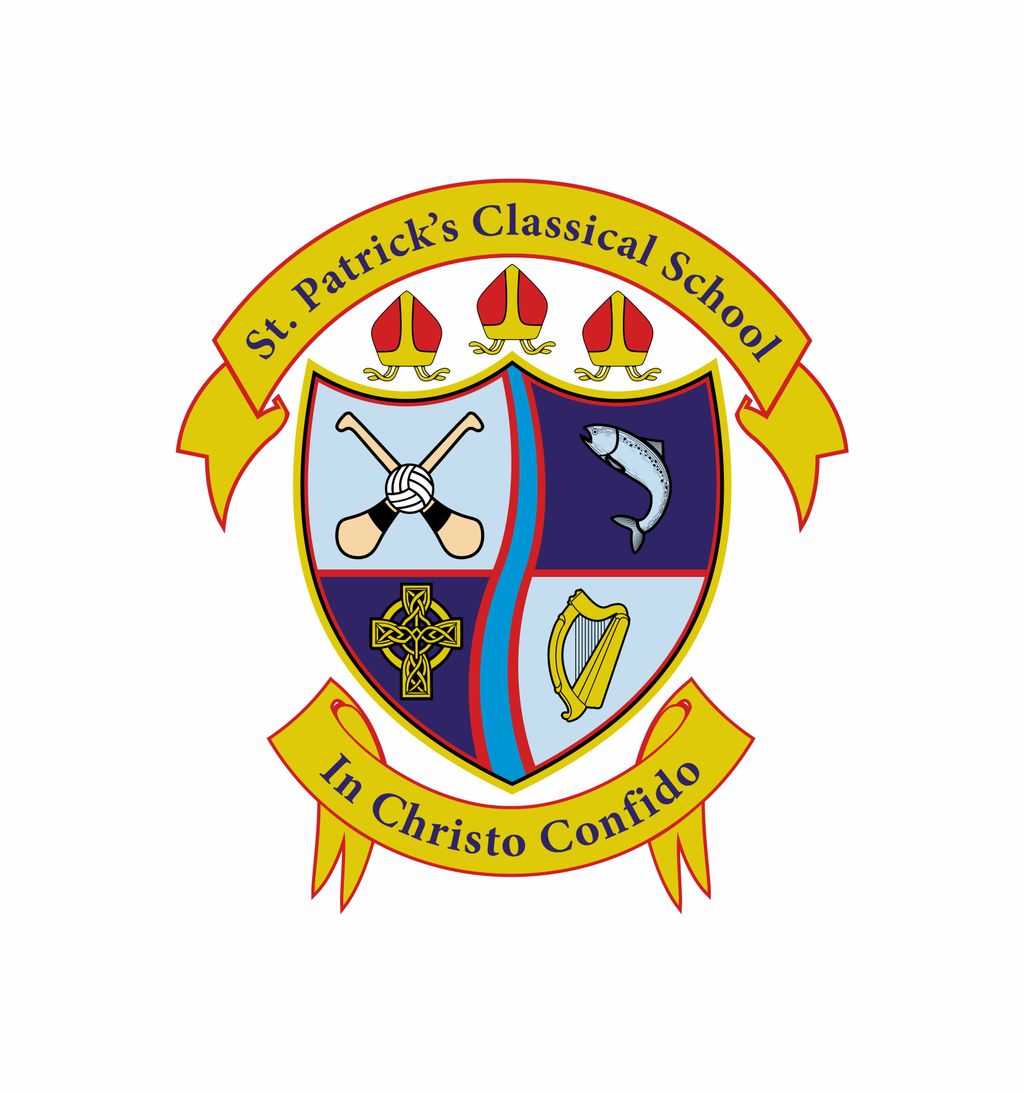
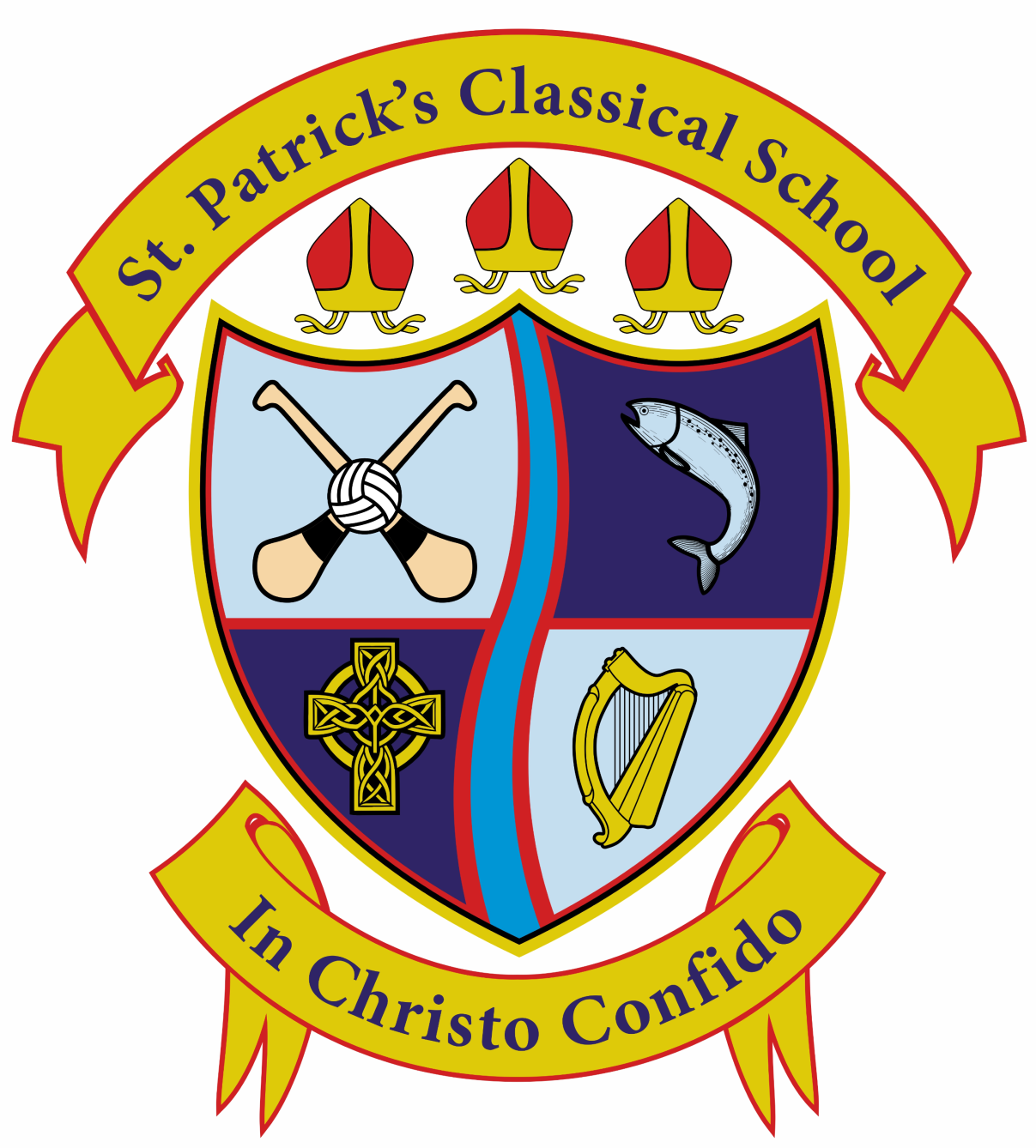
We are very pleased to share with you the launch of our new school crest. This crest has been carefully developed to reflect who we are as a school community, our values, our heritage, and our aspirations for the future. It is a symbol that will represent our school with pride for many years to come.
Background to our change:
Until now, the crest used on our website, headed paper and official school documentation was, in fact, the personal crest of the former Bishop of Meath, Bishop Michael Smith. Following discussions with our current Bishop, Tom Deenihan, about the most appropriate way to address this, it was agreed that, rather than changing the crest each time a new Bishop is appointed, our school should have its own distinct crest.
We agreed that the new crest should acknowledge our identity as a Diocesan school under the patronage of the Bishop of Meath, while also being uniquely ours, and not subject to change over time. On that basis, we began the process of designing a new school crest last year.
This was a collaborative and inclusive process, with significant input from the Student Council and from staff. After several months of discussion, design work and draft proposals, we have agreed on a crest that reflects our school, our traditions and our place within the wider community.
What our new crest symbolises:
The Three Mitres:
In the early Middle Ages, Ireland had a large number of small dioceses, many of them centred on important monasteries. In the area that is now the Diocese of Meath, there were originally eight separate dioceses, Clonard, Duleek, Kells, Trim, Ardbraccan, Dunshaughlin, Slane and Foure. By the early 1100s, the Church decided this system was too fragmented. As part of wider Church reforms across Europe, and influenced by the Normans, Rome sought to reorganise the Irish Church into fewer, larger dioceses with clear boundaries. This process began at the Synod of Rath-Breasaill in 1111 and was completed at the Synod of Kells in 1152, under the supervision of a papal representative, Cardinal Paparo. As a result, the eight dioceses in the Meath area were reduced to three: Duleek, Kells, and Clonard. It was agreed that these three would eventually be merged into a single diocese as the existing bishops passed away. That final merger took place in the early 13th century. Around 1202, Bishop Simon Rochfort moved the main bishop’s seat from Clonard to Trim, effectively creating one united diocese. This new Diocese of Meath covered most of present-day Meath and Westmeath. The three Bishop’s mitres shown on the diocesan crest today commemorate this history, symbolising the three original dioceses—Duleek, Kells, and Clonard—that came together to form the Diocese of Meath.
The Hurleys and Gaelic Football: The hurley and Gaelic football represent our proud tradition of Gaelic Games and our identity as a Gaelic Games school. More broadly, they symbolise Irish culture, community and heritage.
They also reflect our commitment to the holistic development of students, where teamwork, resilience, leadership, inclusion and fair play are valued alongside academic achievement. These symbols acknowledge our strong links with local clubs and the wider community.
The Celtic Cross: The Celtic Cross represents our Christian values and our strong Catholic ethos as a diocesan school. As a symbol that has stood in stone across centuries, it also reflects endurance, moral strength and our commitment to guiding students with care, integrity and purpose.
The Salmon of Knowledge: An Bradán Feasa (The Salmon of Knowledge) is a powerful symbol of wisdom and learning in Irish tradition. It represents our strong academic heritage, the pursuit of knowledge, curiosity, and the transformative power of education. It also reminds us of the responsibility that comes with learning, and the importance of humility and reflection.
The Traditional Irish Harp: The Irish harp is the national emblem of Ireland and a symbol of resilience, creativity and cultural identity. As the only national emblem in the world to be a musical instrument, it highlights the uniqueness of Irish heritage and the enduring spirit of the Irish people.
The River Boyne Running through the centre: The blue band running through the centre of the crest represents the An Bhóinn or the River Boyne. The Boyne is a rich and deliberate symbol. The Boyne anchors the school firmly in Meath. It signals a strong sense of local identity and rootedness, reminding students that their education is shaped by, and contributes to, the heritage of the county. In this sense, the river is a geographic marker of belonging.
The Boyne, flowing steadily through Meath and getting wider as it moves, represents the ongoing journey of education: constant movement, growth, development, and progress. It suggests that learning is not static but something that evolves and carries students forward.
The Latin Phrase: The Latin motto on the crest is In Christo Confido — “In Christ I Trust”. This phrase was chosen following consultation with staff and students and reflects both our faith ethos and the values we seek to instil in our school community. It also allows for continuity as the new crest is phased in across uniforms, jackets and school materials.
I would like to sincerely thank the Student Council and staff who contributed so thoughtfully to this process. The new crest is a symbol of our shared identity and our proud traditions, and I hope it will be worn and displayed with pride by current and future generations of students.
Le gach dea-ghuí,
Harry McGarry
Principal